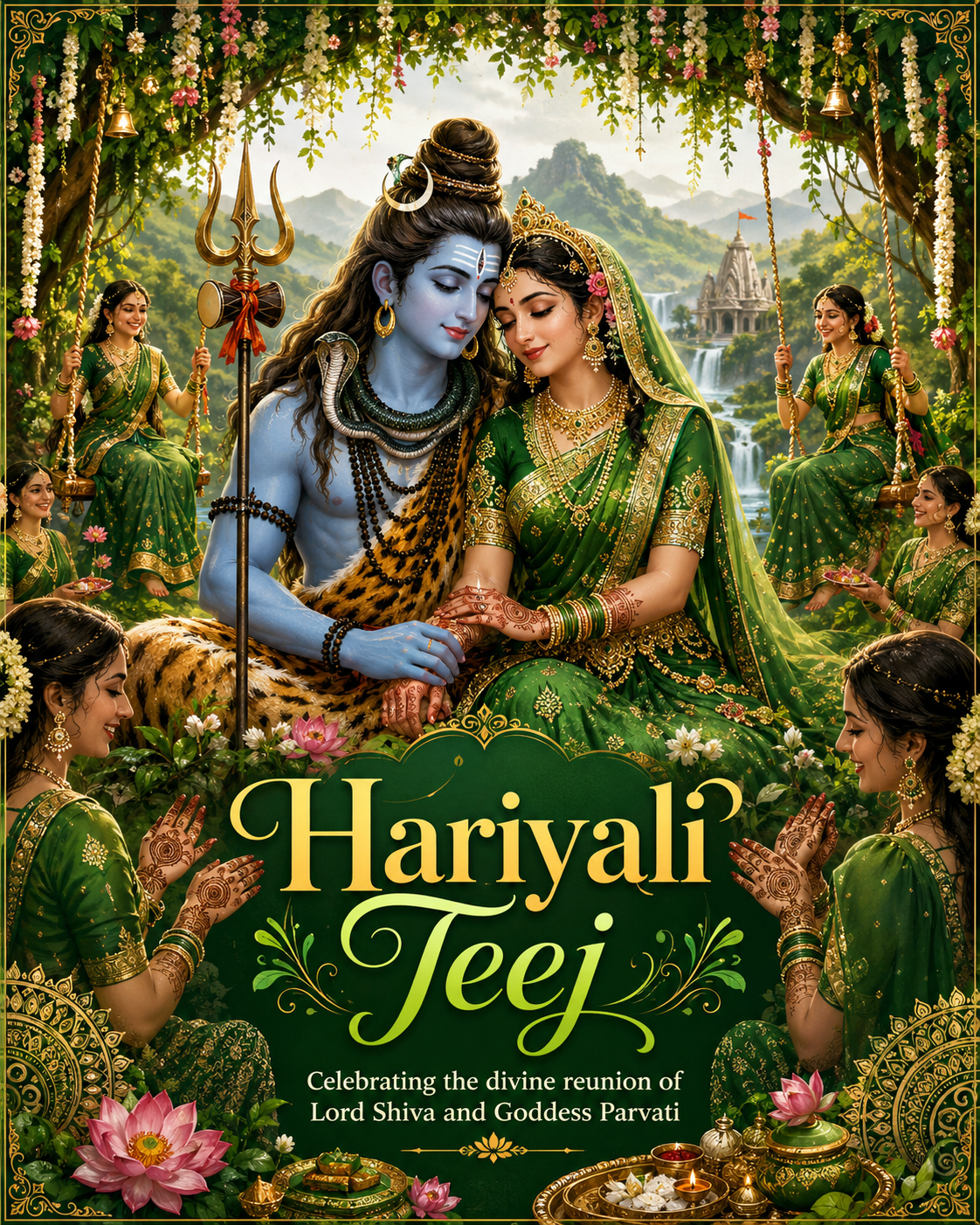
When the monsoon turns the landscape green, Hariyali Teej invites families to pause and celebrate renewal. The festival remembers the union of Goddess Parvati and Lord Shiva, but its message need not remain inside a story from the past. For anyone hoping to marry, it can become a timely question: what kind of commitment am I preparing to offer?
Why is it called Hariyali Teej?
Hariyali means greenery. The festival arrives during the monsoon, when rain brings colour and movement back to the earth. It is also known as Shravana Teej, Sindhara Teej or Chhoti Teej in different communities. It should not be confused with Kajari Teej or Hartalika Teej, which are separate observances later in the seasonal calendar.
The traditional account honours Parvati's steadfast devotion and her reunion with Shiva. Families have long understood this as a prayer for marital harmony and wellbeing. A contemporary reading can hold the devotion while widening the lesson: a healthy marriage asks both partners to show patience, honesty, responsibility and respect.
How families celebrate
Practices differ across Rajasthan, Haryana, Punjab, Uttar Pradesh, Bihar, Madhya Pradesh and other regions. There is no single checklist that every family must follow. Common expressions include:
- Green, red and yellow attire: colours associated with the monsoon, abundance and celebration.
- Mehendi and bangles: festive adornment and time shared among women, relatives and friends.
- Jhulas or swings: decorated swings, often accompanied by Sawan songs, laughter and community gatherings.
- Puja and storytelling: prayers to Shiva and Parvati, flowers, sweets and the retelling of Teej traditions.
- Sindhara: in some families, parents send a married daughter gifts such as clothes, bangles, mehendi or sweets including ghevar.
- Fasting: some married and unmarried women observe a vrat according to family custom; others participate through prayer or celebration.
Fasting is a personal religious observance, not a measure of anyone's love or worth. People who are pregnant, managing diabetes, taking medicines or living with another health condition should follow medical advice rather than social pressure. Marriage itself is mutual; care for its wellbeing should never be placed on one partner alone.
What Teej can inspire before marriage
1. Commitment is a practice, not a performance
Grand gestures are memorable, but marriage is mostly built through ordinary consistency: keeping a promise, speaking respectfully during disagreement, sharing work and turning up when life becomes inconvenient. While learning about a match, look beyond polished introductions and ask how each person behaves when plans change or pressure rises.
2. Patience should not mean silent suffering
Parvati's perseverance is central to the traditional story. In present-day relationships, patience works only alongside dignity and honest communication. It should never be used to excuse control, disrespect, violence or endless uncertainty. A suitable partner does not ask you to abandon your boundaries to prove devotion.
3. Renewal keeps a relationship alive
The monsoon does not merely decorate Hariyali Teej; it gives the festival its emotional language. Good relationships also need renewal. Couples revisit plans, apologise, adapt to career or family changes and create new rituals of their own. Compatibility is not identical taste—it is the ability to navigate difference constructively.
4. Marriage joins lives, not just biodata
A profile can introduce education, work, community and family background. It cannot fully reveal how two people think about money, caregiving, children, faith, household responsibilities or relocation. Those answers emerge through unhurried conversation. Tradition can guide the meeting; clarity must guide the decision.
The most meaningful prayer for a future marriage may be followed by a practical promise: “I will know myself honestly, listen without pretending and choose without pressure.”
A five-question Teej reflection
If marriage is on your mind this season, take ten quiet minutes and write down your answers:
- Which values must be shared, and where can I welcome difference?
- What kind of daily life—not just wedding day—do I hope to build?
- How do I respond to disagreement, and what do I need from a partner during conflict?
- Which expectations about career, money, parents or children must I communicate early?
- Am I choosing from readiness and respect, or from comparison and pressure?
These questions cannot identify a life partner by themselves. They can, however, make your next conversation more truthful—and truth is a stronger beginning than trying to appear perfect.
Let the festival become Sphurthi
Hariyali Teej can be joyful for married women, unmarried women, couples and families without making everyone observe it in the same way. Celebrate with prayer, colour, music, a call to someone you love—or simply a moment of reflection. Customs vary, and that diversity is part of India's living tradition.
For those seeking a match, let the greenery carry a gentle motivation: prepare not only to find the right person, but also to become a clear, caring and dependable partner. That is the spirit in which VivahSphurthi wishes you a meaningful Hariyali Teej.
Sources and further reading
These references support the factual context used in this guide. Customs and family practices can vary by region, religion, community and household.
- Teej: Celebrating love, devotion, and monsoons — Incredible India, Ministry of Tourism, Government of India
- 2026 Hariyali Teej date and time — Drik Panchang
- Unique Festivals of India: Teej — INTACH Heritage Education and Communication Service